
Criminal Court Cases in Erath County
Erath County criminal court cases divide by the level of the charge. The 266th Judicial District Court hears felony prosecutions. Its official file is kept by the District Clerk, not by the sheriff or prosecutor. Class A and B misdemeanor cases go through the County Court at Law, with criminal misdemeanor records held by the County Clerk. That split matters because a valid name search in the wrong court can return no match.
Fine-only Class C matters follow a different route. Justice courts handle cases within their jurisdiction, and Stephenville or Dublin municipal courts retain their own city citations and warrants. One event can even create more than one case number. A city citation may exist beside a later county charge, or separate defendants may have separate files. Start with the expected charge level, then widen the search only when the facts support it.
Erath County Court Records Portal
The county places its Court Records & eDiscovery launch on the Erath County Online Services page. Search by case number when it is known. That identifier is more precise than a name. With only a party name, choose the criminal case type, select the likely court, and use a narrow filing-date range. Then compare the court, filing date, party role, charge, status, and counsel before opening the docket.
The online docket is useful, but it is not always the full clerk file. A register of actions may appear without document images. Older files may be archived, and protected data will be redacted. Texas also offers re:SearchTX as an account-based e-file platform, yet the Texas Office of Court Administration does not treat it as a complete statewide criminal trial-court search. For an Erath County prosecution, the local clerk remains the authority.
Erath County Case Record Searches
A sound Erath County case record search uses the portal as an index and the clerk as the source for missing or certified material. Keep the search criteria and date used. Names alone are not unique, so never rely on a same-name result without comparing the rest of the case header.
- Open Court Records & eDiscovery from the official county Online Services page.
- Select the criminal division and the likely District or County Court at Law stream.
- Enter the case number, or use a party name with a narrow filing-date range.
- Open the result and compare the charge, status, court, events, judgment, and sentence.
- Ask the proper clerk to inspect the file or provide a plain or certified copy when an image is absent.
| Field Label | Type | Required | Notes |
|---|---|---|---|
| Name/Party | Text | Usually no | Use surname and given name; common names need cross-checking. |
| Case Number | Text | No | The strongest identifier when known. |
| Court/Location | Dropdown | No | Choose District for felony or County Court at Law for misdemeanor. |
| Case Type | Dropdown | No | Select criminal when the control is offered. |
| Filing-Date Range | Dates | No | Narrow broad name results by a likely period. |
Portal labels can change with the vendor interface. The county launch page is the stable starting point. If a city citation is the likely record, search the matching municipal court instead of forcing it into the county stream.
Erath County Felony Case Files
The District Clerk is the custodian for Erath County felony case records. The office is in the Donald R. Jones Justice Center, 298 S. Graham Street, Stephenville, TX 76401, and its published phone is 254-965-1486. The court itself uses 254-965-1485. Calling the clerk is the right fallback for an older case, a missing image, an archive question, or a certified judgment.
Visitors enter at South Graham and West McNeill. The county says they pass through a metal detector and must submit bags, purses, and other effects to search. That rule is worth planning for when carrying files or devices. The research does not confirm lockers, parking validation, or a general right to record inside, so those details should be checked before travel.
Erath County District Clerk
Donald R. Jones Justice Center
298 S. Graham Street
Stephenville, TX 76401
254-965-1486
What a Criminal Case File Contains
A court case file is richer in procedure than an arrest report or jail record. It can show the complaint, information or indictment, hearings, counsel, motions, plea, judgment, sentence, costs, and supervision. The docket gives a dated event list. The signed judgment or order is usually the best source for the outcome because a short portal status may hide what happened to each charge.
| Case Number & Court | Identifies the file, court, case type, filing date, and current status. |
|---|---|
| Charging Document | Shows the complaint, misdemeanor information, or felony indictment and charged degree. |
| Docket Entries | Lists filed papers, hearings, motions, pleas, settings, warrants, and other events by date. |
| Parties & Counsel | Names the State, defendant, attorneys, and their roles in the case. |
| Disposition & Judgment | Records dismissal, acquittal, deferred adjudication, or conviction at the charge level. |
| Sentence & Conditions | May show custody, community supervision, fines, costs, restitution, and related terms. |
Public views should not expose Social Security numbers, victim or minor identifiers, protected addresses, or other restricted data. Some documents can therefore appear only in redacted form, while sealed and expunged matters may not appear at all.
Erath County Case Outcomes Explained
Short status labels need care. “Dismissed” means a charge ended without conviction, but one dismissed count does not prove that every count ended the same way. “Acquitted” is a not-guilty result after adjudication. “No bill” means a grand jury declined to indict the presentation. Deferred adjudication means the court withheld a finding while supervision was imposed; it is not the same as dismissal.
- Disposition
- The result of a charge, shown most clearly in the signed judgment or order.
- Capias
- A court command directing that a person be taken into custody.
- Information
- A prosecutor's charging document, commonly used for a misdemeanor.
- Indictment
- A felony charging instrument returned by a grand jury as a true bill.
- Community supervision
- The Texas term commonly called probation.
“Closed” or “disposed” is only an administrative status. It does not by itself say whether the result was favorable. Read the charge-level result and judgment. When a name match remains uncertain, an official fingerprint review can help with one's own Texas criminal history, but it does not replace the local court file. The IdentoGO enrollment channel illustrates the separate identity-based route.

The fingerprint channel confirms identity against DPS-held history, while the Erath County clerk file supplies the motions, docket, judgment, and other local case detail.
Criminal Case Stages in Erath County
Charges begin with a complaint, followed in a felony by grand-jury review and a possible indictment or, in a misdemeanor, by an information. Arraignment is the formal court appearance concerning the charge and plea. Discovery, motions, settings, and negotiation follow. The case may end through dismissal, a plea, or trial. A judgment states the result, and sentencing sets the court-ordered consequence.
Case flow: Charges Filed › Arraignment › Pretrial › Plea or Trial › Disposition › Sentencing
An arrest may come first, but the court file has its own life. Texas Code of Criminal Procedure Article 15.17 generally requires prompt magistration no later than 48 hours after arrest. Magistration covers warnings and bond at the start of the process; it is not a trial or finding of guilt.
Missing Erath County Court Documents
A missing portal image does not prove the document or case is absent. Ask the clerk four separate questions: whether the case exists, whether a docket is available, whether the requested paper is public, and what a plain or certified copy costs. Certification confirms that the copy came from the clerk. It does not alter or validate the court's underlying result.
Use the District Clerk for felony pleadings and judgments, and call the County Clerk Criminal Misdemeanor Records line at 254-965-1407 for Class A or B misdemeanor files. A sheriff's public-information form is not the right tool for an indictment, judgment, sentence, or docket. In the other direction, a clerk cannot provide an arresting officer's narrative if the court never received it. Following the holder prevents the most common dead end.
For a broad county context before tracing a particular prosecution, the Erath County criminal history overview separates court, jail, police, and statewide records.
Erath County PTIP Case Records
Erath County operates a named Pre-Trial Intervention Program through the County Attorney and Community Supervision and Corrections Department. It is a voluntary, discretionary path for selected people. The county identifies such factors as limited prior history, mental-health circumstances, military service, facts of the case, and victim impact. Acceptance is not guaranteed.
The official Erath County PTIP page is the source for the program's stated purpose and administration.
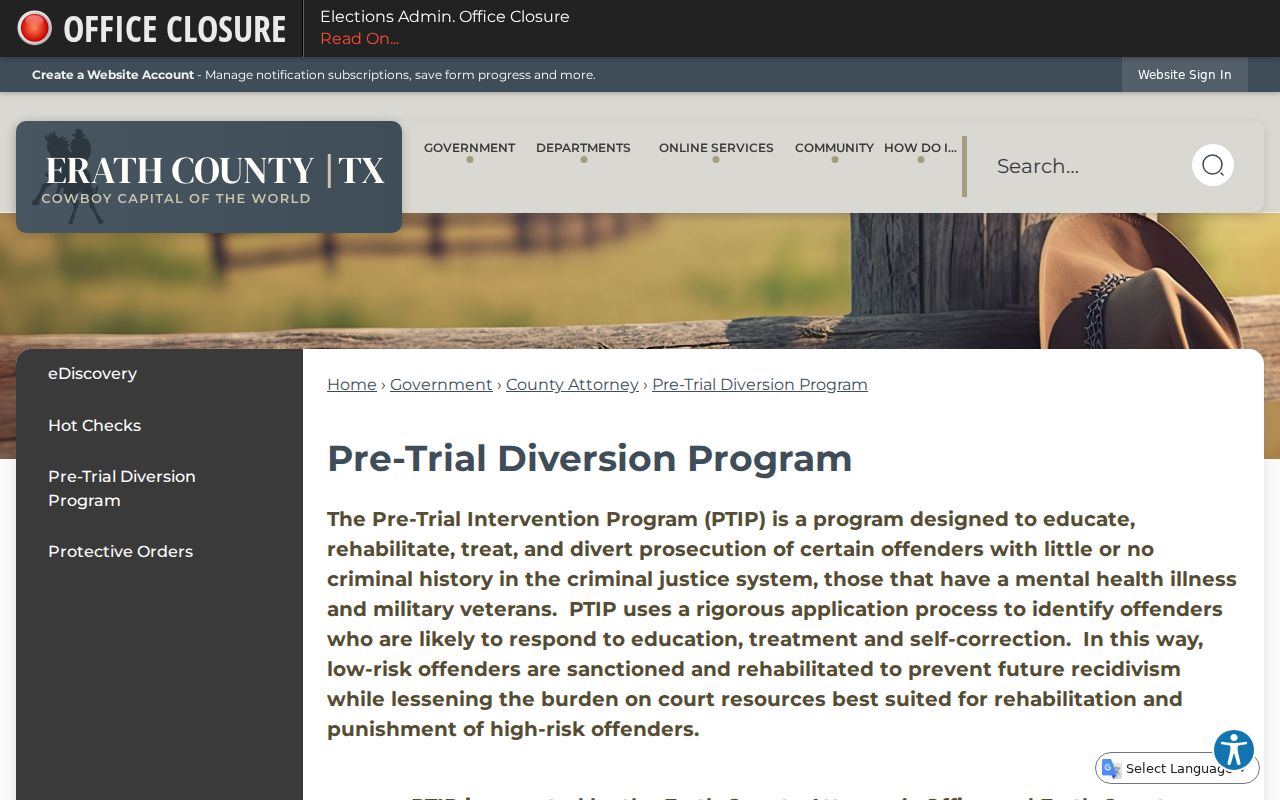
The program page explains the alternative track, but the clerk's docket and final order remain the sources for what is public in a particular Erath County criminal case.
Access Rules for Case Records
Texas court files are judicial records obtained through the clerk's access process, not ordinary executive-agency records requested from the sheriff under the Texas Public Information Act. The Texas judiciary's rules and standards govern court access alongside statutes and court orders. Most routine docket data and filed judgments are public, but access can differ by document and case.
Juvenile records, sealed or expunged matters, victim and minor details, medical information, and sensitive identifiers can be withheld or redacted. An online view may also be narrower than a counter file. If an expected case is missing, contact the clerk and describe the case number, court, date range, and requested document. Do not assume that an empty search proves no case ever existed.
Orders of nondisclosure restrict ordinary public release without destroying every government record. Expunction under Texas Code of Criminal Procedure Chapter 55A is a different remedy. Either can affect what appears in a public Erath County case lookup, so the current clerk response and signed court order carry more weight than an old search result.